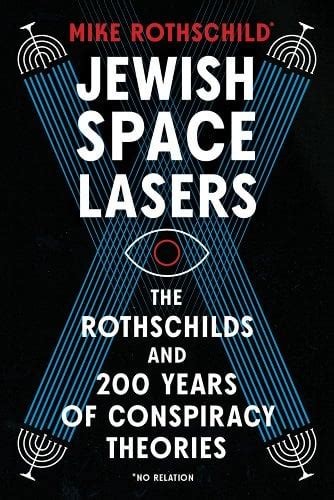

ombres reviewed Jewish Space Lasers by Mike Rothschild
I already knew who Alex Jones was before I read this
2 stars
I wanted to like this book. Really, truly, I did. I heard about it on a podcast (I'm not sure which one) a number of years ago. The author, Mike Rothschild - who is not related to THE Rothschilds, but obviously has the same last name (and is also Jewish, with ancestry in what is now Germany) - talked a good game, and from what I heard, I sort of thought I was going to get a serious history of the Rothschild banking family, one that would put to bed everything lurking in the miasma of contemporary popular discourse ABOUT the Rothschilds, such as it is, but actually shed light on what they did, including how some of it might... be bad. As one might expect for a powerful banking family.
Apparently the book I actually need to read for hard-hitting history about the Rothschilds themselves is one that …
I wanted to like this book. Really, truly, I did. I heard about it on a podcast (I'm not sure which one) a number of years ago. The author, Mike Rothschild - who is not related to THE Rothschilds, but obviously has the same last name (and is also Jewish, with ancestry in what is now Germany) - talked a good game, and from what I heard, I sort of thought I was going to get a serious history of the Rothschild banking family, one that would put to bed everything lurking in the miasma of contemporary popular discourse ABOUT the Rothschilds, such as it is, but actually shed light on what they did, including how some of it might... be bad. As one might expect for a powerful banking family.
Apparently the book I actually need to read for hard-hitting history about the Rothschilds themselves is one that was written by Niall Ferguson (yuck), cited as an important source for Mike's. This book, in 270-odd pages, goes lightning quick over the history of the family, spending a lot of time - in my view, too much time - telling me about this fucking lunatic who wrote this thing about the Rothschilds, then that one, then another one. As I write this review, I have the book turned to a page that quotes from a 2013 letter to the editor of an Ohio newspaper. Elsewhere in the books, we will see quotes from blog posts.
So it's not the book I expected. Perhaps that could have been a good thing. Certainly a history of the Rothschild banking family should include at least some treatment of the conspiracy theories about them - and well, joke's on me, because the fact that they'd be talking about the conspiracy theories is on the front page. There are certainly some interesting ideas and arguments, especially in the early chapters, which speak about the earliest pamphlets spreading dubious or exaggerated information about the Rothschilds. And as someone who actually didn't know almost anything about where the Rothschilds came from, how they made their money, or anything of the sort, I now feel much better informed.
Rather than being a book about the Rothschilds, or even a book about all the conspiracy theories about the Rothschilds, however, the book is in effect about the larger phenomenon of antisemitism - and then, nested within that subject, the struggle of Jews throughout history to overcome this scourge and live their best live, a sort of feel-good story, and one in which the story of the Rothschilds themselves is in fact the best example, which have provided hope for more destitute and desperate Jews during the last two centuries.
On the topic of the former, I find its theory of what antisemitism actually is, and what its relationship is to the larger phenomenon of "conspiracy theories" (and what those even are), to be lacking. This is no "Anti-Judaism: The Western Tradition" by David Nirenberg, which is to say, there is no deep exploration of where this pattern of thought actually comes from, what makes it so consistently appealing to so many people, and what, if anything, gives it ontological substance (which is to say: are we actually talking about the same thing? or different things, happening in different times and places for different reasons, but which we have put in a semantic bucket called "antisemitism" for own reasons?). Mike's presentation is better than a conservative columnist trading in clichés like "antisemitism is the oldest hatred in the world" but not by as much as one might hope, especially when he insists early in the book that "almost all conspiracy theories are rooted in antisemitism, and almost all antisemitism is rooted in conspiracy theories". This is a weasel-wordy statement that sounds true enough, given a particularly historic and cultural vantage point, but as soon as you scratch at what "conspiracy theories" are, it gets a lot more dubious. I had a friend when I was younger who, when he and his ex-girlfriend were on the outs, started to make up micro conspiracy theories about how she was talking behind his back, getting me and other people in his life to ice him out and so on. The emotional function of this theory is obvious, but his ex-girlfriend was not Jewish, and there is nothing meaningfully "antisemitic" about this. At a glance, there seems to be a lot in the story of anti-Chinese sentiment and conspiracy theory in Indonesia that looks very similar to how Christian Europeans thought about Jews, but I think a strong case can be made that this pattern of thought emerged sui generis out of local conditions and perceptions of who was exploiting who, and not as a "translation" of anti-Jewish animus into anti-Chinese animus. Maybe I think the CIA killed JFK. Maybe I think NASA is hiding the fact that the Moon is made out of cheese. Maybe I think there are a bunch of people of Italian descent doing some shady shit and making money off the books - oh wait, that WAS a conspiracy theory, at one point in history, but for decades now it has been an established fact that "the Italian mafia" is a real thing, e.g. a real "conspiracy".
Really, I hate the use of the term "conspiracy theory" to mean "untrue, unfounded belief" because conspiracies do happen and it is probably even okay to speculate that they are happening, i.e. have a theory about them. I myself indulge in such things from time to time - not because I know, but because I don't NOT know. There are plenty of conspiracy theories that are considered credible enough in certain circles that would abhor the term, for instance the conspiracy theory that the September 1999 apartment bombings in Russia were a false flag attack used in part to help Vladimir Putin gain power would be considered fine to say at the same dinner party table where saying Bush did 9/11 would not be. Literature on "conspiracy theory" that' worth its salt should be able to distinguish between a theory about "microconspiracy" and one about "megaconspiracy", where in the former is about if something's fishy about a specific event, and the latter's about if all world events (but not the behaviour of the leader of your specific suburban church congregation) are orchestrated by 12 shadowy dudes on a shadowy council. I would want a book on Rothschild conspiracy theories to make this distinction, and demonstrate why the Rothschilds so often fit into this megaconspiracy thinking - and to some degree, Mike's book definitely does that, but it also sounds like a just-so story, "people just hate Jews who succeed". I don't know, it's not satisfying and I don't think it adequately explains this phenomenon?
This next thing is pretty small: one particularly frustrating part of the book is when, discussing the film "Eyes Wide Shut", he refers to Tom Cruise's character as a "disaffected therapist". Did Mike even watch the movie? The character is some kind of medical doctor, seemingly one who touches breasts in his medical practice - never heard of a therapist - which is plot-relevant insofar as it his something that his wife and him have an argument about in the "that weed is making you aggressive" part of the movie (which is incredible). I bring this up, though, to make the point that Mike seems to be sweeping very quickly through a lot of material and not being very careful with it.
When I was writing this review, I did check the back inside sleeve for the first time, and I actually saw Mike. Very handsome man with a handsome smile. I feel bad shit-talking his book and I learned a lot I didn't know, including about the word "scabrous" which he must have used 10 or 11 times to besmirch the genuinely awful antisemites he wrote about. But I think that as a book that's going to convince anyone of anything, it fails. If you think the Rothschilds control everything, probably, then you will read his book and think "he is a Rothschild!" or "he was paid by the Rothschilds!" or whatever the fuck. And if you think conspiracy theorists are dumb hateful stupid idiots then you will read this book and have that bias confirmed. You will not find interesting insights into why the antisemites are the way they are, or useful reflections on why early socialists were either down or (in modern language) "critically supportive" of antisemitism, nor will you find anything but the most soft criticism of any Rothschild at all.
I'll try to write a review if I ever get around to reading Ferguson's book.